

House Leveling Methods Compared: Pros, Cons & Best Uses


Not all house leveling methods work the same way, and choosing the right foundation repair solution depends on your home's foundation type, soil conditions, and the severity of the damage. Common house leveling methods include helical piers, push piers, soil stabilization, pier and beam adjustments, and basement stabilization.
Some methods help lift and support a settling foundation, while others address shifting soil, weakened structural supports, or bowing basement walls. Understanding these differences can help homeowners make informed decisions about foundation repair.
In this guide, Childers Brothers compares the most common house leveling methods, explains their advantages and limitations, and helps you understand which solutions may be appropriate for your home.
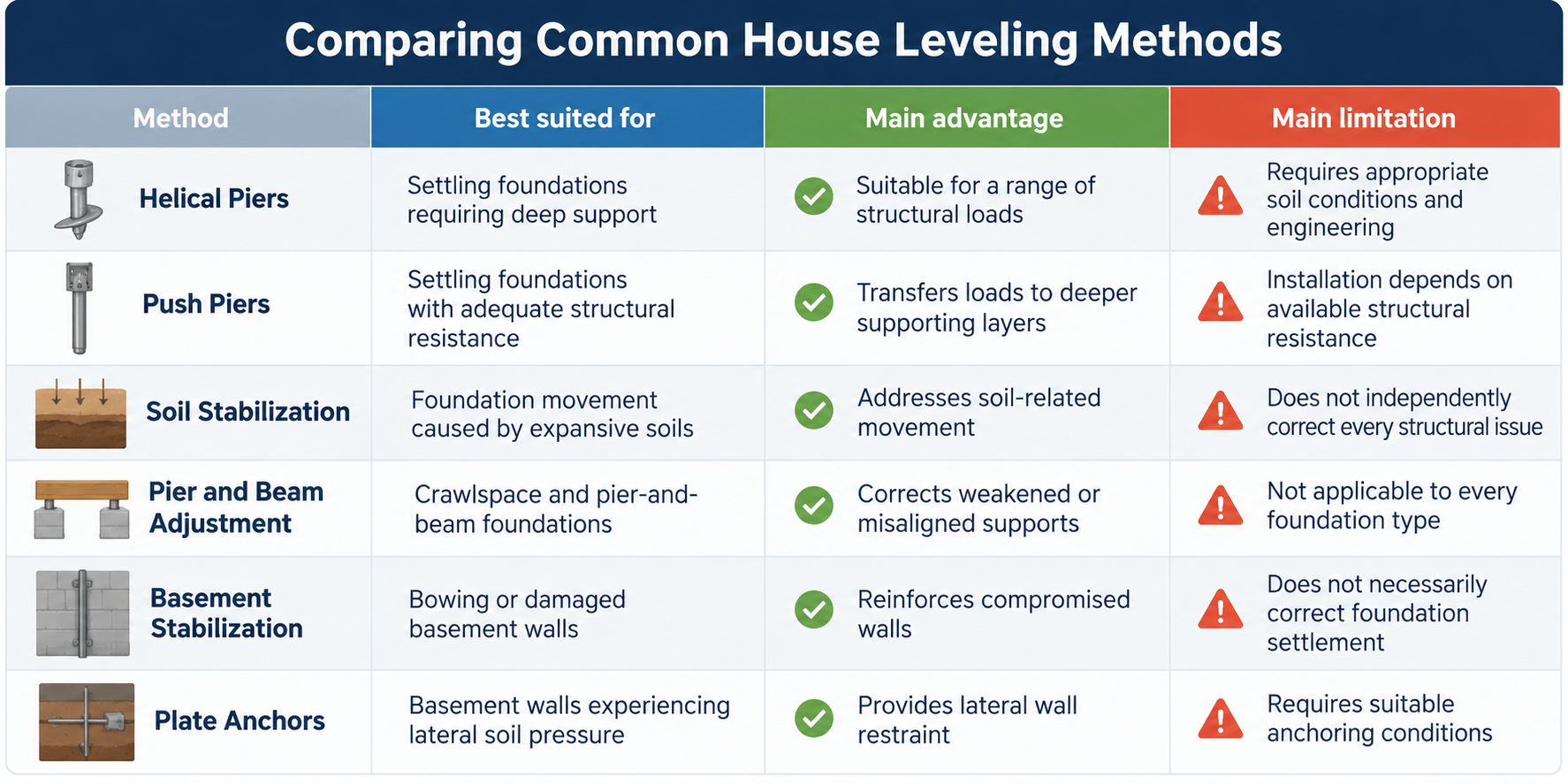
First — Consider Your Foundation
There is no one-size-fits-all when it comes to house leveling. It often depends on your foundation. What helps with slab foundations does not always help with crawlspace foundations, and some basement foundation solutions aren’t very helpful if you don’t have a basement. It also may be that your foundation as a whole needs to be replaced, which is why we list here a few foundational options such as concrete slab or crawlspace.not sure what your trying to say here in this sentence
Soil Stabilization
Soil stabilization is a great option if the issue with your settling foundation is the soil. Soil that becomes too dry can shift too easily and cause your home to sink, while soil that’s too moist can expand and push against the walls of your home. Soil stabilization involves an injection that chemically alters the soil so that it no longer expands or contracts.
Soil Stabilization Pros:
- Installation. Soil stabilization is drilled into the soil through minimally invasive machinery, making it one of the least disruptive methods of leveling your house.
- Long Lasting. We use EcSS 3000, a proven soil stabilizer that chemically alters the soil forever, so you won’t have to worry about the soil being unable to hold your home up.
- Environmentally Friendly. The idea of chemical alteration might not sound like an eco-friendly option, but because our method of soil stabilization is so precise, it causes little damage to the environment.
Soil Stabilization Cons:
- Varying Methods. If you choose soil stabilization, make sure you use EcSS 3000 over something like lime stabilization or calcium-based soil stabilization for best results.
- Specific Issue. This addresses the specific issue of shifting or expanding soil, not other foundational problems you might have.
Basement Stabilization
Have a basement foundation? Notice that the walls might be buckling or cracking? It could be that your basement isn’t stable enough to uphold the rest of the home. Basement stabilization focuses on straightening and stabilizing basement walls to make them stronger than before and better able to uphold your foundation.
Basement Stabilization Pros:
- Wall Strength. Basement stabilization takes your buckling basement walls and reinforces them, often making them stronger than they were in the first place.
- Long Lasting. When done by the right experts, this method will last for decades and you won’t have to worry about your settling foundation again.
- Easy To See the Difference. The proof is on the walls, so you don’t have to look too hard for signs that it’s working.
Basement Stabilization Cons:
- Basement Only. Not every home has a basement, so if your foundation is settling but you don’t have a basement, this won’t be much help.
- Interior-focused. Sometimes those cracks on your basement wall are a sign of issues with the soil, which could mean that you need soil stabilization instead. It’s best to talk to a professional about which best suits your home.
Plate Anchors
Plate anchors are sometimes used when homeowners find bowing walls in their basement. It involves drilling an earth anchor hole into the bowing wall, which is then attached to an anchor through use of a rod. On the interior, a wall plate holds the rod and wall to the anchor plate. Once the plate and the anchor are tightened, the hole used to form the plate anchor is refilled and the sod replaced in your yard.
Plate Anchor Pros:
- Minimal Disruption. Although plate anchors require digging up part of the yard, they do not require a full excavation, and the disruption to the soil is relatively minimal.
- Long Term Solution. Plate anchors are tough and offer a long-term solution to the issue of soil pushing on the basement walls.
- Effective Immediately. Plate anchors start working as soon as they’re installed.
Plate Anchor Cons:
- Requires Digging. Helical piers, for instance, are drilled into the ground, while soil stabilization is injected through a very thin hole. Plate anchors require some amount of excavation, which can be problematic if you have a flowerbed nearby.
- Could Be Interrupted By Tree Roots. If you have a tree near enough to the house that the roots reach the foundational soil, you may not be able to use plate anchors.
- Needs Adjustment. While it does work in the long run, it’s not one-and-done and may need some adjustment in order to continue to work.
Pier and Beam Adjustment
Crawlspaces are often upheld by piers and beams, and over time, those piers and beams can become weakened, thus making the foundation prone to sinking. We realign your piers and repair any fallen beams in order to strengthen them and stabilize your crawlspace foundation.
Pier and Beam Adjustment Pros:
- Simple. This is not a complete overhaul but rather a reinforcement of a system that you already have, which can make the labor less intensive and the cost a little easier.
- Top Products. We use top products backed by careful installation to ensure that this form of house leveling holds up for years.
- Analysis Backed. We start this process with a 27-point analysis so we can pinpoint exactly what the problem might be before committing to pier and beam adjustment.
Pier and Beam Adjustment Cons:
- Specific. The main drawback to this version of house leveling is that it’s specific to crawlspaces. If you have a different kind of foundation, then this won’t apply for obvious reasons.
Push Piers
Push piers have long been a classic option when it comes to settling foundation, and boast long-term effects, but there are drawbacks to this method, as well. Push pier foundation repair involves steel piers that are pushed into the foundational soil all the way to the load-bearing stratum through use of a hydraulic ram. Pier brackets anchor them to the foundation, and the weight of the structure becomes the “resistance mass” that helps to keep the foundation from settling again.
Push Pier Pros:
- Can Be Installed In Small Spaces. Push piers are installed through hand-held equipment and can fit into small spaces, which makes them an option where other methods might not be.
- Great For Heavy Buildings. Because it uses the weight of the structure as the resistance mass, push piers are popular when it comes to the foundation repair of commercial buildings or large homes.
Push Pier Cons:
- Can’t Handle Lighter Structures. The fact that push piers use the weight of the building as resistance mass can be a boon…or a curse. If you have a smaller structure, such as a 1 story family home, it might not be heavy enough for push piers to be effective.
- Won’t Work With Broken Footings. Push piers are anchored to the foundation with pier brackets, but if the foundation footing is damaged, push piers won’t be effective.
- Cannot Be Removed. Once push piers are installed, you can’t move them or adjust them. They’re compression-fit. In fact, if you plan to add onto your home, you’ll have to add push piers rather than move them around to make room for the new addition.
Helical Piers
Our personal favorite when it comes to house leveling methods is helical piers. This method uses steel piers with screw-like features that are drilled deep into the ground to raise the settled foundation of your home. Like push piers, helical piers are made with heavy-duty steel run deep to the load-bearing soil, but they have benefits that push piers don’t.
Helical Pier Pros:
- Can Hold Light Loads. These piers function like screws holding your home to the foundation. They are not dependent on the weight of the structure, and thus can handle smaller, lighter buildings.
- Can Be Adjusted and Moved. Need to add onto your home? Helical piers can be removed and placed in a different location to accommodate your home addition or other construction changes.
- Installation. No excessive mess. These helical piers will be drilled precisely where they need to go in order to raise your foundation. It’s also a faster installation process than push piers.
- Environmental Impact. The environmental impact of helical piers is relatively low, perfect for the eco-conscious homeowner.
- Can Work With Broken Footing. Is the footing of your foundation damaged? No problem. Helical piers can still be installed to securely hold up your home.
Helical Pier Cons:
- Soil Dependent. Instead of relying on the weight of the building, helical piers rely on the density of the foundational soil. If the soil is not dense enough for helical piers to be effective, shafts can be added to the project until there are enough helical piers to hold up the structure securely, but this can drive up material and labor costs.
How Do You Know Which House Leveling Method Is Right for Your Home?
Choosing the right house leveling method begins with understanding what is causing the foundation to move. Not every foundation problem requires the same repair approach, and some homes may need a combination of solutions to achieve long-term stability.
Foundation repair professionals evaluate several factors before recommending a leveling method.
Foundation Type: Slab, Pier and Beam, or Basement
Different foundation types require different repair techniques. Concrete slab foundations may benefit from engineered pier systems when settlement is occurring, while pier and beam foundations may require adjustments to existing supports, replacement of damaged components, or additional structural reinforcement.
Soil Conditions and Foundation Movement
Expansive clay soils can swell when moisture levels increase and shrink during dry conditions. These changes can contribute to foundation movement, particularly in areas of Texas where soil moisture fluctuates throughout the year.
Severity of Settlement or Structural Damage
Minor movement may require a different approach than significant foundation settlement, uneven floors, or structural cracking. The extent and cause of the damage help determine whether stabilization, lifting, or another repair method is appropriate.
Long-Term Stability and Repair Requirements
A successful foundation repair should address the underlying cause of movement whenever possible. Depending on the property, this may involve deep foundation support, drainage improvements, soil stabilization, or adjustments to existing structural components.
Childers Brothers can help homeowners understand their foundation's condition through a professional evaluation and its 27-point analysis.
How Much Does House Leveling Cost?
The cost of leveling a house depends on several factors, including the type of foundation, extent of settlement, soil conditions, and repair method required.
Some repairs involve adjusting existing foundation supports, while others require installing engineered piers or addressing unstable soil conditions.
Factors affecting house leveling costs include:
- Foundation size and construction type
- Number and depth of piers required
- Severity of foundation settlement
- Soil conditions and accessibility
- Excavation, labor, and engineering requirements
- Additional repairs needed to address underlying problems
Because every foundation is different, the most reliable way to determine repair costs is through a professional inspection.
House Leveling vs. Foundation Stabilization: What's the Difference?
Although the terms are sometimes used interchangeably, house leveling and foundation stabilization are not exactly the same.
House leveling involves correcting elevation differences caused by foundation settlement or movement. Depending on the foundation type and condition, this may involve lifting portions of the structure or adjusting existing supports.
Foundation stabilization focuses on preventing or limiting additional movement by strengthening the foundation or improving the support beneath it.
Some foundation repair methods accomplish both objectives. For example, certain pier systems can stabilize a settling foundation and, when conditions allow, lift portions of the structure closer to their original elevation.
However, not every stabilization method physically raises a foundation. Basement wall anchors, for instance, are generally intended to resist lateral wall movement rather than correct vertical foundation settlement.
Understanding this distinction can help homeowners better evaluate recommended foundation repairs.
Which House Leveling Methods Work Best for Texas Homes?
Texas homeowners face foundation challenges related to expansive clay soils, fluctuating moisture levels, and periods of prolonged dry weather.
When soil absorbs moisture, it can expand and exert pressure on a foundation. During dry conditions, the same soil may shrink, potentially reducing support beneath portions of the structure.
For homes in Amarillo, Lubbock, and surrounding West Texas communities, the appropriate foundation repair method depends on the property's soil conditions, foundation construction, and underlying cause of movement.
Helical piers, push piers, pier and beam adjustments, and soil stabilization may each be appropriate in different circumstances.
A professional foundation evaluation can help determine which solution offers the most suitable long-term support.
Concerned about uneven floors, foundation cracks, or signs of settlement?
Contact Childers Brothers to schedule a professional foundation evaluation and learn which repair options may be appropriate for your home. We stand by helical piers as a house leveling method for almost any home, but ultimately you have to choose the method that’s best for you. Contact Childers Brothers, Inc. today for more information about our house leveling methods including helical piers, soil stabilization, and basement stabilization or to get started with a free estimate.
House Leveling FAQs
What is the best method for leveling a house?
The best method depends on the foundation type, soil conditions, and cause of movement. Helical piers and push piers can provide deep structural support, while pier and beam adjustments and soil stabilization address different foundation problems. A professional evaluation helps determine which method is appropriate.
How much does it cost to level a house?
House leveling costs vary depending on the foundation's size, the extent of settlement, soil conditions, and repair method required. A professional foundation inspection can help determine the appropriate repair and provide a project-specific estimate.
Can you level a house without replacing the foundation?
Yes. Many settling foundations can be stabilized or lifted using engineered pier systems or other targeted repairs without replacing the entire foundation. The feasibility of these repairs depends on the foundation's condition and the cause of movement.
What is the difference between helical piers and push piers?
Helical piers are screwed into the ground using specialized installation equipment, while push piers are hydraulically driven using resistance from the structure. Both systems can provide deep foundation support, but the appropriate method depends on structural loads, soil conditions, and engineering requirements.
How long does house leveling last?
The longevity of a house leveling repair depends on the method used, soil conditions, installation quality, and whether underlying causes of movement are addressed. Properly engineered foundation repairs can provide long-term structural support.