


Basement Stabilization & Bowing Basement Wall Repair
Science-Based Solutions to Straighten, Strengthen & Stabilize Your Basement Walls
Bowing, buckling, or cracked basement walls can be signs that pressure around your foundation is affecting the structural integrity of your basement. Left unaddressed, continued movement may lead to more significant foundation and structural problems.
Childers Brothers provides professional basement stabilization and bowing basement wall repair solutions designed to strengthen damaged walls and help prevent additional movement. Depending on the condition of your basement, our solutions may include H-beam stabilization or carbon fiber reinforcement.
Before recommending a repair, we start with our free 27-Point Analysis to evaluate your foundation, identify the source of the problem, and determine the appropriate stabilization method for your home.
Concerned about your basement walls? Schedule your free 27-Point Analysis today.
Signs Your Basement Walls May Need Stabilization
Basement wall problems don't always appear suddenly. Foundation and soil movement can gradually place pressure on basement walls, resulting in visible changes over time.
Schedule an evaluation if you've noticed signs such as:
- Bowing or leaning basement walls
- Horizontal, vertical, or stair-step cracks
- Cracks that continue to widen
- Walls that appear to be buckling inward
- Uneven or shifting floors
- Doors or windows that stick or no longer close properly
- Visible signs of foundation movement
Not every crack means your basement needs structural repair. That's why determining what is causing the movement is an important first step.
What Causes Basement Walls to Bow or Crack?
Basement walls are constantly exposed to pressure from the soil surrounding your foundation. Changes in soil and moisture conditions can increase that pressure and eventually cause basement walls to crack, bow, or move inward.
Simply repairing the visible crack may not solve the underlying structural issue. Effective basement stabilization starts by identifying why the wall is moving and selecting a repair method appropriate for those conditions.
Childers Brothers uses its 27-Point Analysis to thoroughly evaluate your foundation before recommending a solution.
How Do You Repair a Bowing Basement Wall?
The right method for repairing a bowing basement wall depends on factors such as the severity of the movement, condition of the wall, and forces contributing to the problem.
Childers Brothers offers proven basement wall stabilization solutions, including H-beam systems and carbon fiber reinforcement.
Rather than expecting homeowners to determine which repair they need, our team evaluates the basement first and recommends a solution based on the actual condition of the foundation and walls.

HH-Beam Basement Wall Stabilization

For basement walls requiring substantial structural support, H-beams can provide a strong stabilization solution.
Our H-beams are constructed from high-grade steel and custom-fit to the basement. The beams reinforce affected walls and provide additional structural support to help prevent continued inward movement.
One important advantage of our H-beam system is that installation can be completed without exterior excavation, reducing disruption around your home.
The beams can also be tightened over time when appropriate, providing a long-term approach to stabilizing affected basement walls.
Carbon Fiber Basement Wall Reinforcement
Carbon fiber reinforcement provides another effective option for stabilizing certain bowing or cracked basement walls.
Carbon fiber is exceptionally strong while maintaining a thin, low-profile appearance. Reinforcement is installed directly against the affected wall, helping provide additional strength without taking up significant basement space.
Benefits of carbon fiber basement stabilization include:
- Strong structural reinforcement
- Low-profile installation
- No bulky support system extending into the room
- Minimal maintenance
- Paintable surface
- Long-term stabilization
For homeowners who plan to finish or continue using their basement as living or storage space, the low-profile nature of carbon fiber can be particularly appealing.

We Provide Other Basement Stabilization Solutions, Too!
H-beams and carbon fiber sheets are just two possibilities we offer for stabilizing your basement. The solution we use for your specific situation depends on the results of our 27-Point Analysis.
At Childers Brothers, we practice Science-Based Solutions. In other words, we don’t come to your home with a solution already in hand; instead, we fully diagnose your issue before we determine a remedy. This allows you to get the guaranteed BEST solution… a solution that’s done once and done right.
So before you take action on signs of bowing, buckling, or cracked basement walls with your Amarillo-area home, get in touch with us. Our 27-Point Analysis is free and will reveal the full extent of the problem to you. Even if you choose not to move forward with us after the analysis (don’t worry—we’re anti-sales pressure!), you’ll still have all the information you need to make the best decision for your home. That’s a promise.
H-Beams vs. Carbon Fiber: Which Basement Stabilization Method Do I Need?
Both H-beams and carbon fiber can provide effective basement wall stabilization, but they're designed for different situations.
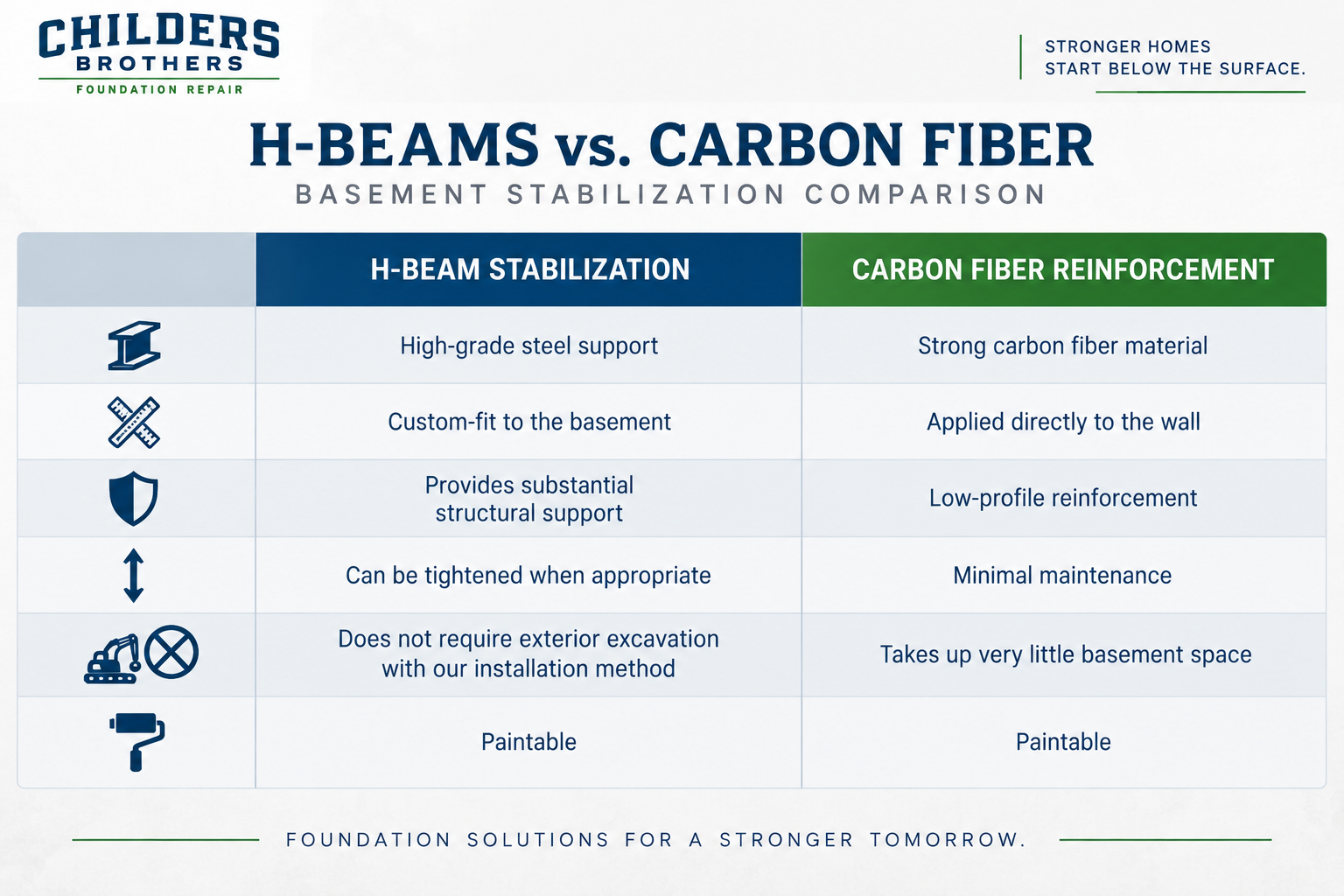
You don't need to diagnose the problem or choose a repair method yourself.
During your free 27-Point Analysis, Childers Brothers will evaluate the basement wall, foundation, and surrounding conditions to determine which solution is appropriate.
Why Choose Childers Brothers for Basement Stabilization?
A basement stabilization system is only as effective as the diagnosis and installation behind it. Childers Brothers takes a comprehensive approach to foundation repair rather than automatically recommending the same solution for every home.
A Thorough Foundation Analysis
We begin with our 27-Point Analysis to understand what's happening with your foundation and basement walls before recommending repairs.
Multiple Stabilization Solutions
Because different foundation problems require different solutions, we offer multiple basement stabilization methods, including H-beams and carbon fiber reinforcement.
Solutions Designed to Minimize Disruption
Depending on the recommended repair method, basement walls can often be stabilized without extensive disruption to your property. Our H-beam installation, for example, does not require exterior excavation.
Decades of Foundation Repair Experience
Childers Brothers has been helping property owners address foundation problems for more than 50 years. Our experience allows us to evaluate each property individually and recommend solutions based on its specific structural conditions.
Our Word-Is-Bond Warranty
We stand behind our foundation repair work with our Word-Is-Bond Warranty, giving homeowners additional confidence in their investment.
Start With Our Free 27-Point Analysis
Seeing a crack or bow in your basement wall tells you that something has changed—but it doesn't necessarily tell you why.
That's where our 27-Point Analysis comes in.
Our team performs an in-depth evaluation of the foundation and basement to determine what's contributing to the problem. From there, we can explain what we found, whether stabilization is necessary, and which repair method makes sense for your property.
Schedule your free 27-Point Analysis and get answers about what's happening with your basement walls.
Basement Stabilization FAQs
What is basement stabilization?
Basement stabilization is the process of reinforcing basement walls and structural components to prevent movement, bowing, or collapse. Techniques like carbon fiber reinforcement and steel H-beams are commonly used to restore strength and stability.
What causes basement walls to bow or crack?
Bowing or cracked basement walls are typically caused by hydrostatic pressure from surrounding soil, poor drainage, or expansive soils that push against the foundation over time.
How do I know if my basement needs stabilization?
Common signs include horizontal wall cracks, bulging or leaning walls, water intrusion, sticking doors/windows, or uneven floors in your home.
Can a bowing basement wall be repaired?
Yes. Depending on the severity and cause of the movement, bowing basement walls can often be stabilized using structural reinforcement systems such as H-beams or carbon fiber.
What repair methods are used for basement stabilization?
Professionals may use carbon fiber straps, steel beams (H-beams), wall anchors, or other reinforcement systems to stabilize walls and prevent further movement.
Is basement stabilization a permanent solution?
Yes, when properly installed, basement stabilization systems are designed to provide long-term structural support and prevent future damage.
Should I repair a bowing basement wall right away?
A bowing wall should be professionally evaluated rather than ignored. Continued movement can potentially lead to more significant structural problems. An inspection can help determine the severity of the issue and whether immediate stabilization is necessary.
Don't Ignore Signs of Basement Wall Movement
Bowing, buckling, and cracked basement walls can indicate a larger foundation problem. The sooner you understand what's causing the movement, the sooner you can determine the appropriate next step.
Childers Brothers can evaluate your basement with our free 27-Point Analysis and recommend a stabilization solution based on what we find—not a one-size-fits-all repair.
Schedule Your Free 27-Point Analysis Today